🧩 Give Your Thumb a Route | Pocket Route Slider
🧩 Give Your Thumb a Route | Pocket Route Slider
Couldn't load pickup availability

🧩 Give Your Thumb a Route | Pocket Route Slider
A desk break with fewer things to gather
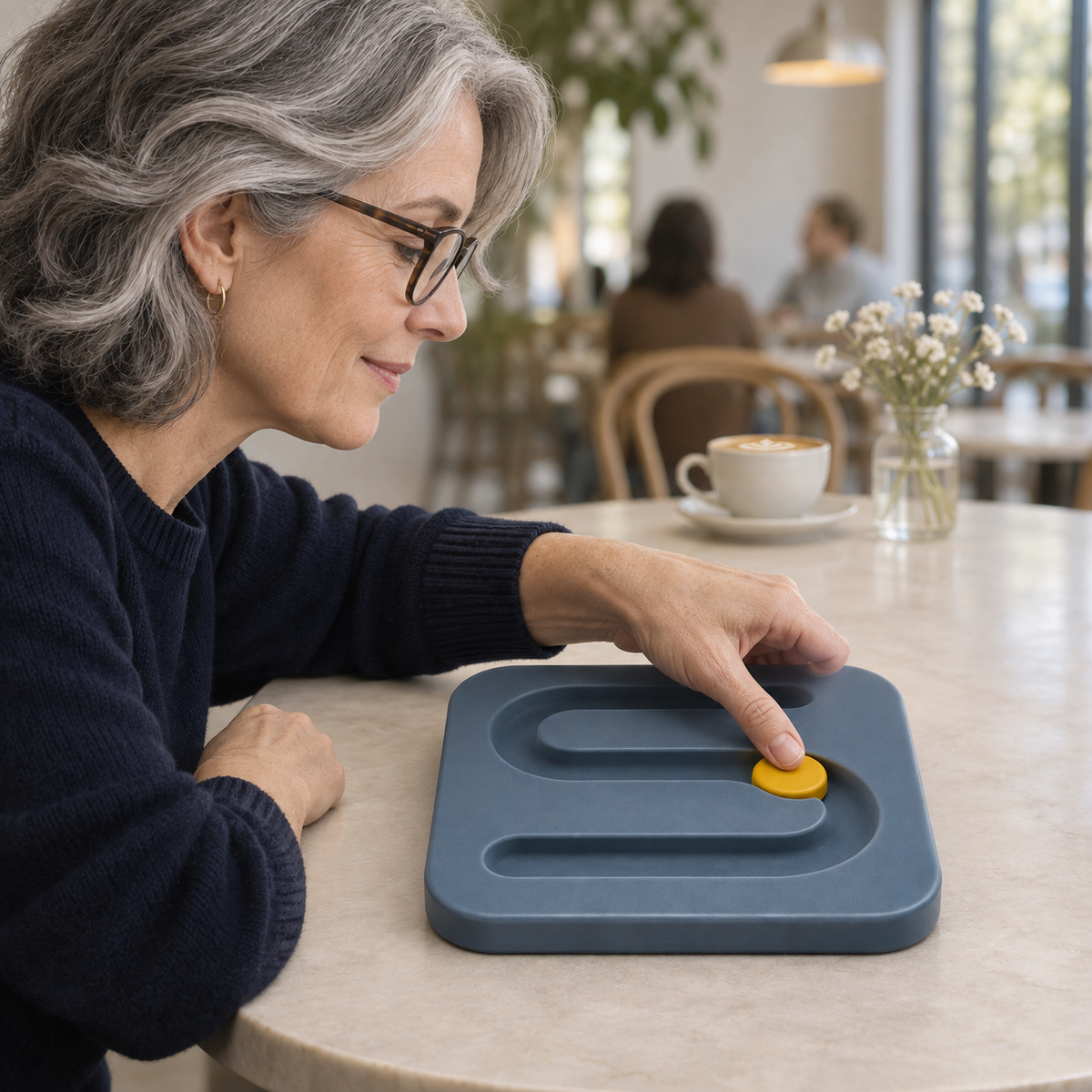
If a quick tabletop puzzle starts with finding pieces, clearing a whole surface or remembering the rules, it can feel like another task. Pocket Route Slider approaches that problem with a single visible action. Put a finger on the yellow puck and guide it along the recessed S-shaped track. The concept keeps the route in view from start to finish, so you can begin at either end and stop wherever your attention needs to go.

The route is the activity
The proposed slider uses one puck designed to stay in one recessed track. Push it toward one end, follow the curve, then bring it back. For a variation, turn the tray around before repeating the route. What looked like a rightward turn from one side now comes toward you from a different angle. You can also use your other hand or try to make a smooth pass at a slower pace. Those are optional ways to play, with no timing or scoring system required.
Why the layout stays simple

A mustard-yellow puck stands out against a slate-blue tray. The recessed channel visibly sets out where the puck is meant to move. Rounded corners soften the outline, and the square format gives you four obvious orientations to try. The design leaves the tray surface free of markings, arrows and numerals. You can decide which end to start at simply by looking at where the puck is sitting.
Follow the bends, one move at a time

Set the tray down on a clean, level surface. Rest a thumb or fingertip on the yellow puck and follow the open direction of the channel with light pressure. At a curve, change the direction of your push as the path turns. When you reach the end, reverse direction or rotate the tray and start again from your new viewpoint. This is the intended motion of the concept. The feel of the puck in the track will need to be confirmed on a physical sample.
A different setup from a loose-piece puzzle
A loose-piece puzzle asks you to lay out components and often to match them to a board or to one another. Here the proposed activity uses a single captive puck and a single route. The setup is the tray itself. That makes it a natural concept for a brief repeatable action on a small work surface. If you prefer changing layouts or puzzles with multiple solutions, look at the other activities in the collection.
Keep it where the action makes sense
A clear area beside a laptop gives the tray a place to sit during a short break. On a shared table, one person can slide the puck to an end and pass the tray over for the next turn. A study desk offers another straightforward setup, especially if you want an activity that stays within the outline of the tray. In each case a stable surface gives you a consistent starting point.
If you keep it on a shared surface, finish your turn with the puck at the end nearest the next person. They can see where to begin without a separate set of instructions.
Check the details before choosing
The proposed configuration is one slate-blue square tray with rounded corners, one recessed S-shaped track and one mustard-yellow captive puck. No separate puzzle pieces are planned. Final dimensions, materials, finish, weight, track clearances and packaging are pending verification. If available space matters, compare the confirmed footprint with the place where you intend to keep it once measurements are published.
Two questions worth asking
**Does it have different difficulty levels?** The concept has one fixed route. Changing the tray orientation, the direction of travel or the hand you use gives you ways to vary the same activity. No difficulty rating is proposed.
**What should I look for in the final product details?** Look for the confirmed tray dimensions, care information and what the finished package contains. If a single guided movement is the kind of desk break you want, the route and puck shown here give you a clear idea of the intended play.