🌀 Orbit Loom Spinner — Give the Table a Turn
🌀 Orbit Loom Spinner — Give the Table a Turn
Couldn't load pickup availability

🌀 Orbit Loom Spinner — Give the Table a Turn

The In-Between Moment
Your notes are spread across the desk, and the next thing on your list can wait for a moment. Clear a small space, set down Orbit Loom Spinner and try one turn. The concept is a tabletop top for adults who enjoy a simple physical activity between other tasks. The action fits on an ordinary work surface and gives you something concrete to watch as the top starts, settles and eventually comes to rest.
Three Places to Try It
At a home desk, place it beside the notebook you use to start or end the workday. In a shared workspace, move it to an open spot on a table where there is room to observe from the side. At home after dinner, two people can trade turns and compare how they launch it. Each setting offers a slightly different experience. A low viewing angle emphasizes the movement of the stem, while looking down gives a clearer view of the color bands.
Give Yourself Room to Spin
Start with a stable, level surface and move cups, pens and loose papers away from the spin area. Set the top upright on its tip. Hold the short stem between your thumb and finger, twist and release it. Let it come to rest before picking it up. If it tips early, try another release with a lighter grip or a more upright starting position. That simple feedback gives you a reason to try again and compare your own technique.

Watch from Where You Sit
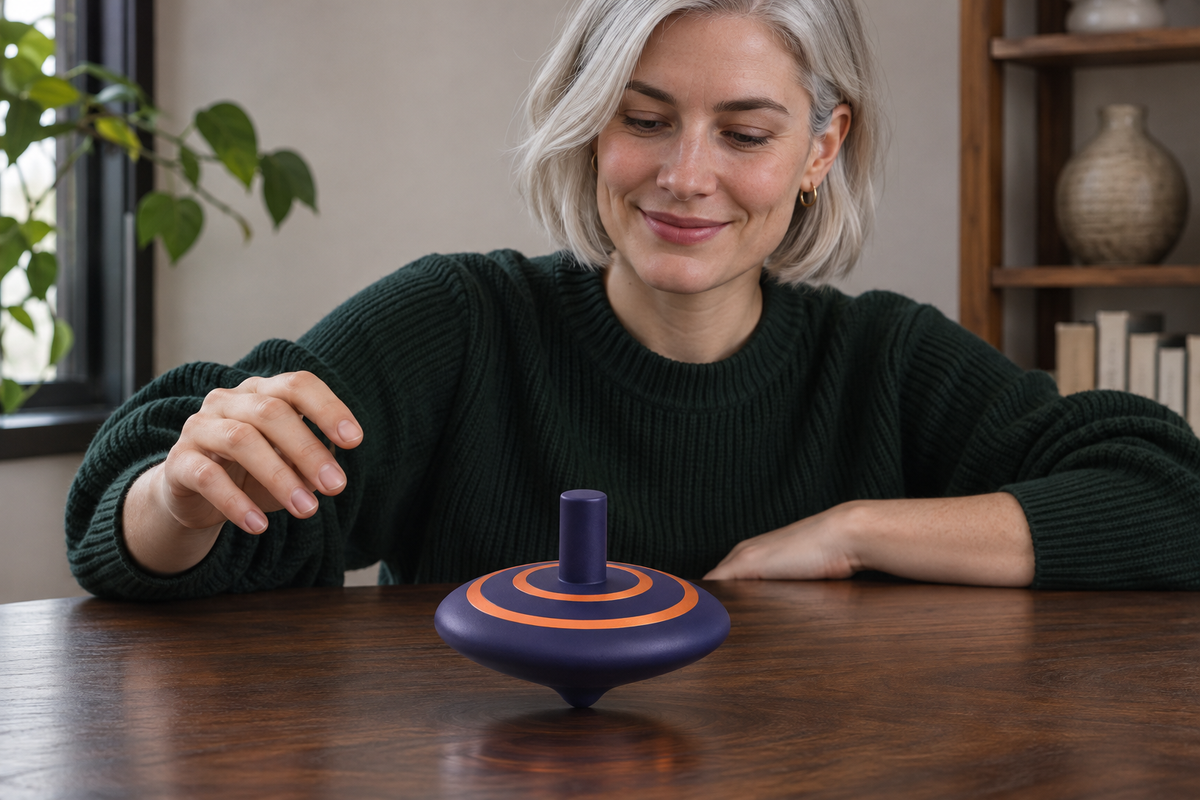
From across the table, the proposed spinner reads as a low indigo shape with a short vertical stem. Up close, the two copper-orange bands give you features to follow as the upper face turns. Try one launch from a seated position, then watch a second from directly above. If you share the table with another person, take turns choosing the viewing angle. The same movement can feel visually different from one position to the next.

Small Details Behind the Motion
The proposed form combines a circular domed body with a centered grip and a rounded contact tip underneath. The central grip is the part you hold to start the spin. The underside tip is the point that meets the tabletop, while the upper face carries the bands. This arrangement gives each visible element a clear role. The surface treatment is envisioned as matte indigo with copper-orange accents, with the final finish and underlying materials still to be verified.
What to Expect from the Concept
The proposed package contains one spinner with no separate pieces. Exact diameter, height, weight, materials and packaging will be confirmed against a physical sample. The images show the intended appearance and general proportions. Spin duration, balance characteristics and behavior on particular surfaces are also pending verification. When evaluating a sample, try it on the level surface you actually use and observe how it starts and comes to rest before making any comparisons.
Who Will Reach for It?
One way to share it is to pass it across the table after each spin. The first person can try a gentle launch and the next can attempt the same motion from a different seat. Compare where each launch begins and how the top settles. If you are using it alone, keep the setup the same and focus on one visual detail per turn, such as the outer band or the position of the stem.
Orbit Loom Spinner is designed around an easy-to-understand tabletop action. It may appeal to adults who enjoy mechanical objects, repeatable gestures or small visual experiments. It could also work as an item two guests pass across a coffee table. For a first session, try a few turns and change only one part of the launch each time. There is enough to observe in the release itself, the turning bands and the final moment when the top comes back to stillness.