Cosmic Rover Building Adventure | A Bold Orange & Blue Explorer for New Planets & Imaginative Missions
Cosmic Rover Building Adventure | A Bold Orange & Blue Explorer for New Planets & Imaginative Missions
Couldn't load pickup availability

Cosmic Rover Building Adventure | A Bold Orange & Blue Explorer for New Planets & Imaginative Missions

🚀 Mission Accepted: Turn an Ordinary Table into an Extraordinary New World.
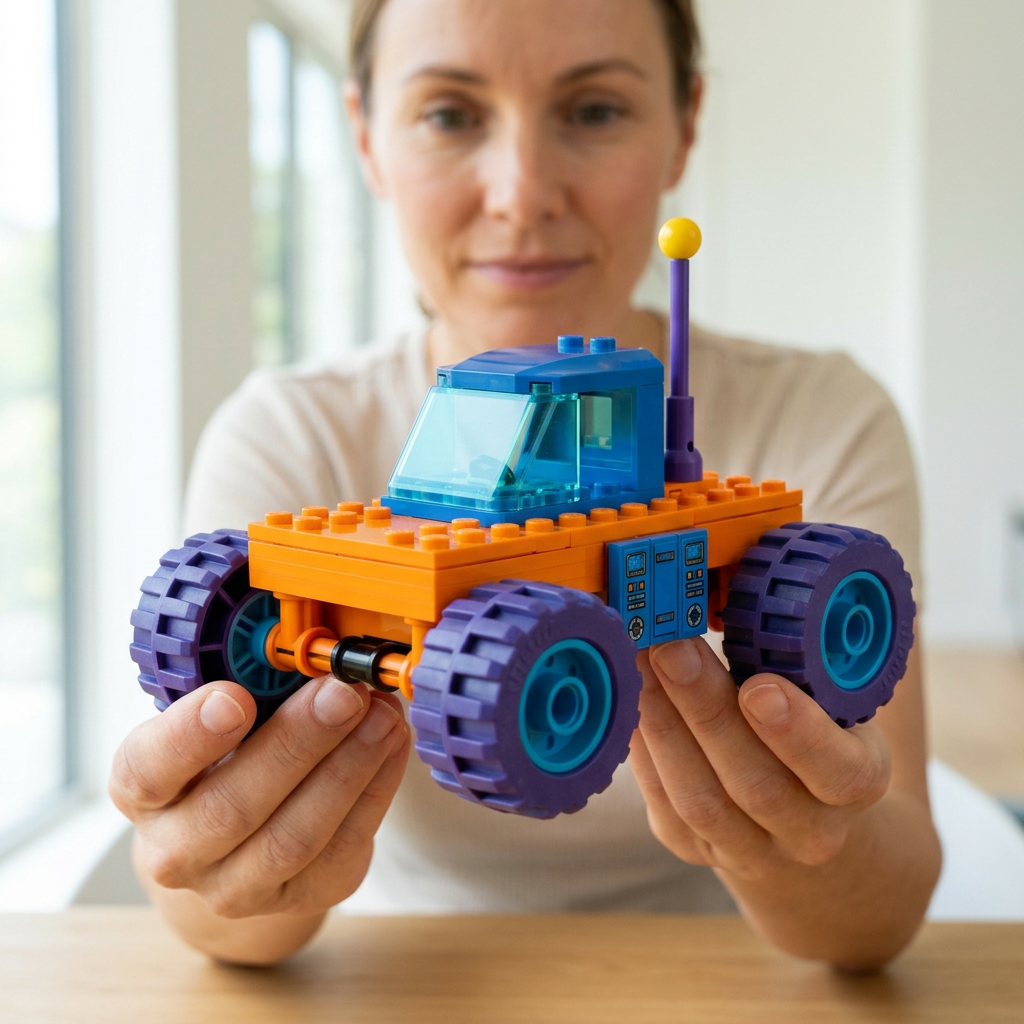
Some adventures begin with a map. Others begin with a vehicle that looks as though it already has somewhere exciting to go. Cosmic Rover brings together a vivid orange chassis, a blue cabin, a cyan-tinted windshield and four dark purple wheels in a space-explorer concept with a bold, unmistakable personality.
The setting does not need to be complicated. A patch of light can become the edge of a distant crater. A color in a drawing can inspire the surface of a new planet. The rover supplies the visual starting point; the destination, the problem and the discovery belong to the people telling the story.
Mission File: Know Your Explorer
The low orange body creates a strong horizontal line beneath the raised cabin. Its warm tone stands out against the cool blues around the driver's area. Purple wheels frame the vehicle at the sides, with blue centers repeating the cabin color. Behind the cabin, a purple antenna rises to a small yellow tip, a bright final accent in the overall silhouette.
Look closely at the windshield angle, the patterned wheel surfaces and the blue details on the side of the body. They suggest a vehicle prepared for an expedition without overwhelming the design with a complicated visual language. The small side markings are decorative details in the concept, not evidence of electronic instruments or working controls.
Briefing One: Name the Planet Before You Land
Begin with three questions: what is the planet called, what color is the landscape, and what makes this place different from home? A world with purple sand will feel very different from a world where every mountain is transparent. Neither needs a detailed model to exist. A good description can make the tabletop feel like an entirely new place.
Give the crew a reason to visit. Perhaps a research station has sent a mysterious message. Perhaps an unfamiliar shape has appeared on the horizon. Or perhaps the rover is simply the first vehicle to arrive in a place nobody has described before. Curiosity can be a mission all by itself.
Briefing Two: Choose the Job
The signal search: an imaginary beacon is sending a message that repeats every few minutes. Where might it be coming from? The supply route: a distant station needs an important delivery, but the most obvious path is not available. The first survey: the crew must describe three things about the landscape before deciding where to establish a base.
Each scenario offers a different kind of story. One is a mystery, one is a journey and one is an observation task. You can keep the same destination and change the job, or keep the same mission and invent an entirely different planet. The concept does not lock the explorer into a single fictional universe.
Field Note: Obstacles Can Be Part of the Story
A pretend crater does not need to test the physical vehicle. It can be a spoken challenge: “The direct route is closed. What should the crew do?” A make-believe dust storm can become a reason to pause and plan. An unexpected visitor can change the mission from exploration to a conversation.
These prompts describe imaginative scenarios, not verified abilities to climb, cross rough terrain, withstand drops or operate outdoors. Keeping the challenge in the story leaves room for problem-solving ideas without turning a photograph into a promise about mechanical performance.
Mission Control Is a Role, Too
For a shared session, let one person describe the planet and another describe the crew's response. Mission control might receive a puzzling report: “We have found a hill that appears to be humming.” The explorer decides what to ask next. Swap roles after each discovery so the same person does not always control the whole adventure.
You can make the exchange playful or thoughtful. A very official mission controller may insist on a formal report about the strangest pebble in the universe. A more imaginative controller may ask whether the planet has a favorite color. Both approaches begin with listening to what the other person has added.
Design Close-Up: Strong Color, Clear Character
Orange gives the rover its visual energy. Blue makes the cabin distinct from the body below it. The purple wheels create a darker outline near the surface, while cyan and yellow provide smaller points of contrast. This limited set of recurring colors keeps the design coordinated even though the overall impression is bright and playful.
The concept image presents one assembled vehicle. It does not propose a bundled astronaut, remote controller, second rover or landscape set. The buildable direction is part of the design brief, but final connectors, assembly steps and component counts have not yet been established by a physical production sample.
Debrief: Tell the Part Nobody Expected
When the mission ends, do not stop at “we arrived.” Ask what surprised the crew. What did they change their mind about? What would they tell the next explorer to bring? A short debrief can become the opening of the next journey, especially when someone remembers a detail that everyone else overlooked.
A drawing, a spoken report or a planet name can preserve that detail without requiring additional product accessories. If you choose to make paper maps or mission badges at home, they are optional creative additions rather than items represented as supplied with the rover.
The Next Destination Is Still Unnamed
One day the mission is a rescue, another day it is a quiet survey, and another day the crew simply wants to know what lies beyond an imaginary hill. Cosmic Rover is a concept for that feeling of possibility: a bright explorer, a new horizon and a story that is ready whenever you are.