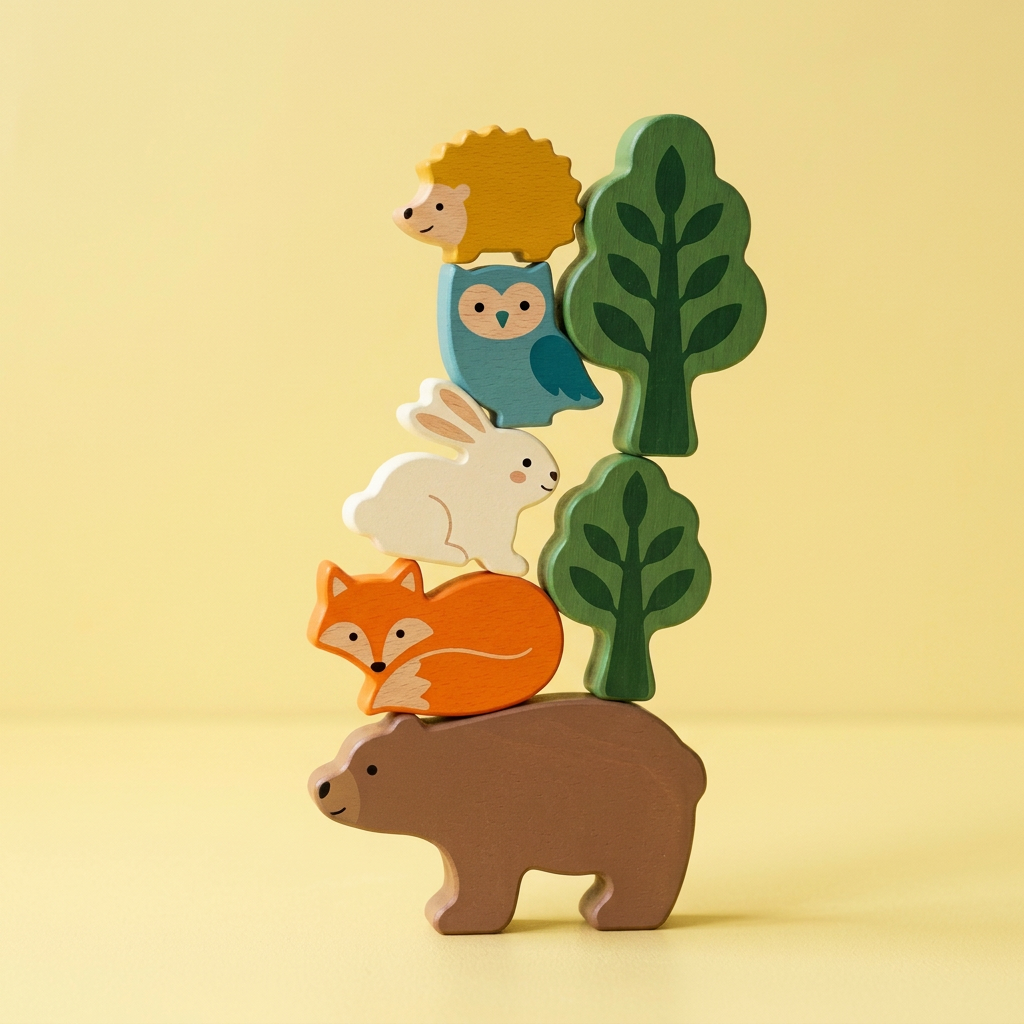
Woodland Animal Stacking Adventure | Five Forest Friends, Two Leafy Trees & Stories Waiting to Begin
Woodland Animal Stacking Adventure | Five Forest Friends, Two Leafy Trees & Stories Waiting to Begin
Couldn't load pickup availability

Woodland Animal Stacking Adventure | Five Forest Friends, Two Leafy Trees & Stories Waiting to Begin

🦊 A Small Forest. A Colorful Cast. A Story That Belongs to You.
Somewhere between an ordinary afternoon and an imaginary woodland, a brown bear has an idea. The fox wants to help. The rabbit is already asking questions, the owl is watching carefully, and the little hedgehog appears to know a shortcut. Two leafy trees mark the edge of their world. That is all the scenery a good beginning needs.
Woodland Animal Stacking Adventure brings these characters together in an illustrated play concept with warm earthy tones, lively accents and a storybook feel. There is no single hero, no printed plot and no final chapter to reach. The appeal is a familiar cast that can return in a different story every time you meet them.
Meet the Forest Before You Build It
The bear introduces a deep brown foundation to the palette, with a broad body and an unmistakable side profile. The fox adds a bright orange curve, a pale face and a sweeping tail detail. Beside them, the cream rabbit feels light and alert, with long ears and a neatly outlined face. The teal owl brings a cool note, and the mustard hedgehog finishes the group with a sunny splash of color.
The trees do more than fill the background. Their green silhouettes and leaf markings establish a setting for the characters, giving the collection a sense of place. Looked at together, the animals and trees feel connected without becoming visually identical. Each shape has enough personality to stand out in the story.
Chapter One: The Invitation
Imagine that the fox is hosting a gathering in the clearing. What will the invitation say? Who will arrive first? Will the bear bring a song, or will the rabbit insist on organizing everything? Before deciding where a shape belongs, decide why its character has come. Suddenly the arrangement is not simply a collection of objects. It is a little scene with a reason to exist.
For shared storytelling, let each person choose a character. One begins with a sentence, the next adds a detail, and the story moves around the table. A shy owl can become a very confident narrator. A serious bear can tell the silliest joke. Nothing in the illustrated faces limits the personalities you create.
Chapter Two: A Different View of the Same Forest
A woodland scene does not have to grow upward. You can imagine a parade crossing the clearing, a meeting between the trees or a quiet line of neighbors watching the sunset. The tall composition in the concept image is one visual direction, not the only way to think about the collection.
Talk about who belongs beside whom and how the story changes when a character moves. If the fox waits near a tree, perhaps it is hiding a surprise. If the bear faces away from everyone else, perhaps it has noticed something exciting in the distance. Position becomes a storytelling tool rather than a demand to reproduce a particular photograph.
Chapter Three: When Plans Change
The best woodland tales rarely go exactly as expected. An imaginary breeze might scatter the picnic. A character might forget the way home. The hedgehog might announce that the party is actually tomorrow. A small change gives everyone a new question to answer: what happens next?
This is also a gentle way to approach the idea of stacking in a future production version. An arrangement that changes need not end the play; it can create a new scene. The concept's pictured tower has not been physically tested, so it should be read as an illustration of the design direction rather than a promise of stable balance.

Look for the Details That Give Each Character Its Voice
The fox's curled silhouette makes it feel settled, almost as though it is listening. The rabbit's ears make its profile immediately recognizable. The owl's pale face contrasts with its teal body, and the hedgehog's outline creates a different edge from the smoother forms nearby. These little visual differences give a storyteller something specific to notice and use.
Try describing one character without naming it. “I am thinking of someone with very long ears.” Then try a less obvious clue: “I am thinking of someone who might know a secret path through the trees.” The first clue comes from the image; the second comes from imagination. Both can open a conversation.
Three More Stories Hiding in the Clearing
The missing moon: the animals wake up to discover that the moon is not in its usual place. Each has a different theory about where it went. The very quiet concert: the forest wants to celebrate without waking a sleeping neighbor. What kind of performance could they invent? The unexpected visitor: someone arrives who has never seen a tree before. How would the animals describe their home?
None of these stories requires an additional purchased accessory. They begin with conversation and the characters already pictured. Any paper scenery, drawings or household props you choose to introduce are optional additions, not represented as part of the proposed product.
A Collection That Feels Like One Little World
The warm orange, brown and mustard colors keep the forest grounded, while teal, cream and leafy green bring contrast. The repeated illustrated style ties the pieces together. Rather than relying on a famous character or a branded setting, the concept builds its identity through shape, palette and the relationships between its woodland neighbors.
That gives the collection a gentle continuity. A different arrangement can still feel like the same forest. A new story can still feel like a visit with familiar characters. It is a world small enough to begin with a single sentence and open enough to keep that sentence going.
Leave the Last Page Unwritten
When one adventure ends, ask each character what it wants to do tomorrow. You may discover that the fox is opening a café, the owl is going on holiday or the bear would simply like a quieter picnic. The next chapter is already there, waiting for someone to tell it.